

Marcel Desailly has reignited a debate surrounding the 2025 Africa Cup of Nations by delivering a straightforward analysis of the competition’s final outcome and its interpretation. In an interview with Flashscore, the former French international defender addressed the issue of the African champion title, focusing on the reality of the game rather than institutional decisions.
He believes that evaluating the winner of a major tournament cannot be limited to administrative conclusions or decisions made outside the pitch. He argues that on-field performance throughout the competition should remain the central element in any assessment of sporting merit. In this context, he mentioned the controversial situation surrounding Morocco and its status as the 2025 AFCON champion, a designation that sparks debates in certain circles of African and international football.

Marcel Desailly, a 1998 World Cup champion and 2000 European champion with the French team, emphasizes the distinction between pure sporting competition and administrative procedures. He believes these two dimensions should not be confused, even if they coexist in the organization of major international competitions.
In his analysis, he highlights that players and coaching staff primarily remember what happened on the pitch, regardless of legal appeals or disciplinary committee decisions. For him, the sporting memory of a tournament is built by performances, results achieved on the field, and experiences lived in the locker rooms, rather than by the subsequent deliberations of governing bodies.
It is in this context that he made particularly strong statements about the situation of the 2025 AFCON. He declared:
“You can’t say Morocco won the AFCON. On the pitch, for me, the African champion is still Senegal,” Desailly stated, insisting that sporting truth is determined primarily on the field.
The former international continued to elaborate on the duality between sporting and administrative decisions. He pointed out that commissions, appeals, and legal procedures are integral to modern football, but they belong to a different sphere than the competition itself. According to him, these elements can influence official results, but they do not necessarily change the sporting perception of the involved parties.
“Then there are administrative decisions, commissions, appeals… That’s a different story. It’s up to the courts to decide. But for the players, for the locker room, what they remember is what they experienced on the pitch,” he added.
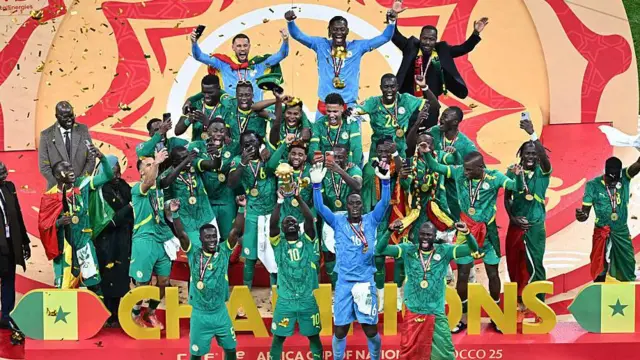
This stance reignites the debate on how titles and competitions are perceived, balancing official recognition and sporting sentiment. Desailly’s comments shed light on a recurring fracture in modern football: the tension between sporting legitimacy, built on the pitch, and institutional legitimacy, validated by governing bodies.
By speaking so directly, the former French defender offers a critical perspective that is sure to provoke reactions, especially in a context where international African competitions are regularly scrutinized and subject to multiple interpretations.


