

For several days now, a document presented as an “arbitral award” from the Court of Arbitration for Sport (CAS) has been circulating widely on social media. According to this text, the Lausanne-based court would have annulled a decision by the Confederation of African Football (CAF) and officially awarded Senegal the title of winner of the Africa Cup of Nations (AFCON) 2025. This news quickly sparked excitement among many Senegalese supporters. However, upon closer inspection, several major inconsistencies show that this document cannot be considered authentic.
The first point that raises eyebrows is the case number mentioned in the document. It bears the reference CAS 2026/A/10857. However, the appeal officially filed by the Senegalese Football Federation (FSF) was registered by the CAS under a completely different number: CAS 2026/A/12295. This reference appears in the official statement published by the Court of Arbitration for Sport on March 25, 2026. Each case registered with the CAS receives a unique number that cannot be changed or replaced. This discrepancy is a major inconsistency and seriously undermines the credibility of the document shared online.
The timeline of events also reveals numerous anomalies. The alleged arbitral award is dated June 10, 2026 and claims that the dispute is definitively resolved. Yet, when announcing the admissibility of the FSF’s appeal, the CAS clearly stated that the procedure was just beginning. The court explained that an arbitration panel still needed to be formed, a procedural timetable would be set, and the various parties would have several weeks to submit their briefs and present their arguments. At this stage, no hearing or decision date had been scheduled.
This temporal contradiction makes the supposed decision particularly suspicious. A procedure before the CAS follows specific steps that cannot be shortened without exceptional justification. The existence of a final judgment on the date mentioned in the document appears incompatible with the information officially communicated by the arbitration body. This strongly reinforces the hypothesis of a fake document designed to mislead internet users.
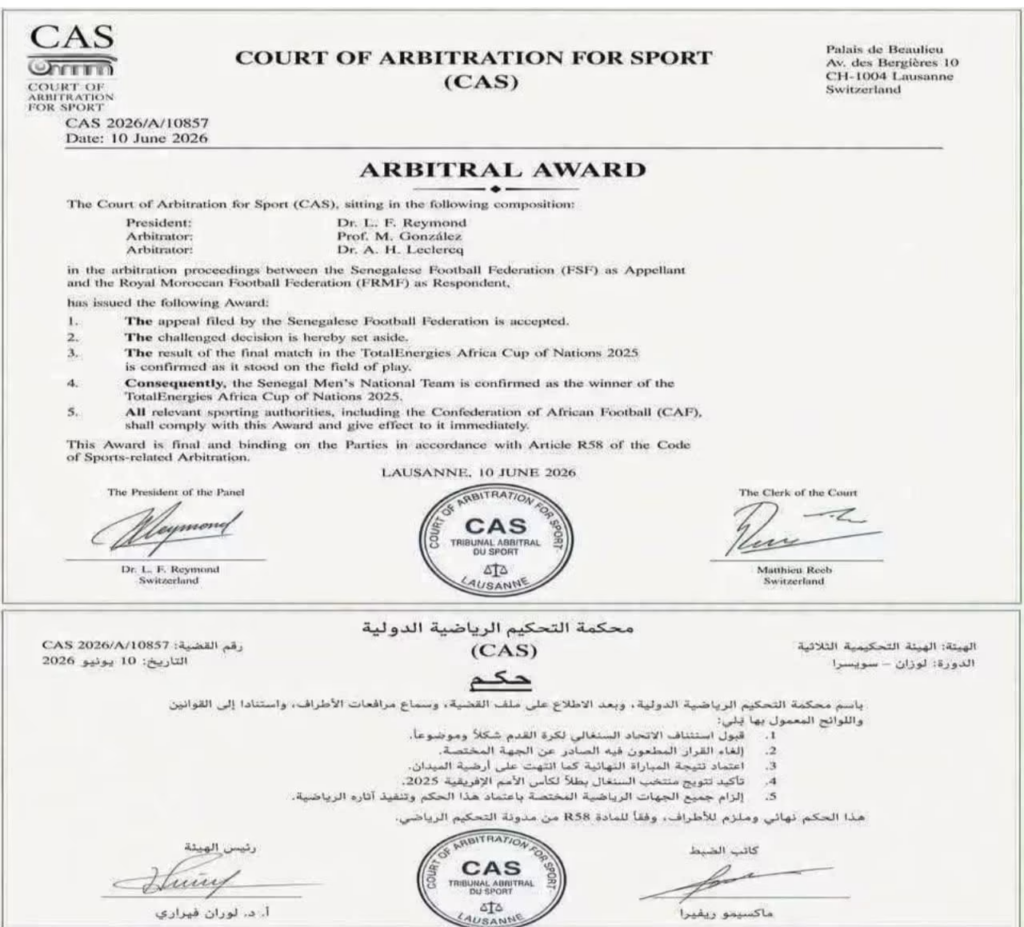
Other formal elements also raise questions. Several experts who examined the document noted differences in presentation, layout, and the legal wording used. Some passages do not match the style typically employed by the Court of Arbitration for Sport in its official decisions. Even if these details may seem minor, they add to the already noted inconsistencies and strengthen doubts about its authenticity.
To date, no official decision from the CAS has confirmed Senegal as the winner of AFCON 2025. No statement published by the Court of Arbitration for Sport or the Confederation of African Football mentions such a verdict. In the absence of an official communication from the relevant bodies, the document circulating on social media should be considered inauthentic. Supporters are therefore urged to refer only to information published through official channels to avoid spreading false information.
The content of the supposed decision also raises questions. The document claims that the FSF’s appeal is accepted, that the contested decision is annulled, that the match result is confirmed, and that Senegal is officially declared the winner of AFCON 2025. Such a decision would necessarily have been subject to an official statement from the CAS even before the potential dissemination of the arbitral award. Yet, no announcement of this nature has been published by the institution.
🚨 FAKE NEWS | Beware of this false decision from the Court of Arbitration for Sport (TAS/CAS)
An image presented as an official ruling from the Court of Arbitration for Sport (TAS/CAS) is currently circulating on social media. It claims that Senegal has officially… pic.twitter.com/28RT9yGm5C
— Momar Assane (@Noo_IDcard) July 11, 2026
Lack of Official Communication
Another telling point: this document is only circulating as an image on social media. There is no official statement from the TAS, CAF, or the Senegalese Football Federation confirming its existence. No authenticated version of the decision is available on official channels, while a verdict of such significance would have been widely reported by the relevant institutions and major international sports media.
Finally, the presence of the TAS logo, an official seal, and a layout similar to authentic documents does not prove reliability. These graphic elements are easily accessible and can be reproduced. Given all the checks carried out — incorrect case number, timeline inconsistent with official procedures, lack of institutional communication, and limited distribution to social media — everything indicates that this supposed arbitration ruling is a forged document intended to mislead the public.


