

Senegal has stepped up to challenge the recent statements made by Aleksander Ceferin. Alongside Algeria, Morocco, and several other federations, the FSF has strongly condemned the UEFA president’s comments about the new 48-team World Cup, which he claimed would feature some “meaningless” matches.
In a joint statement signed with the federations of Cape Verde, Curaçao, Haiti, Uzbekistan, and the DRC, while showing support for South Africa, Algeria, Ivory Coast, Egypt, Ghana, Morocco, and Tunisia, Senegal firmly reminded everyone what the World Cup means for many nations.
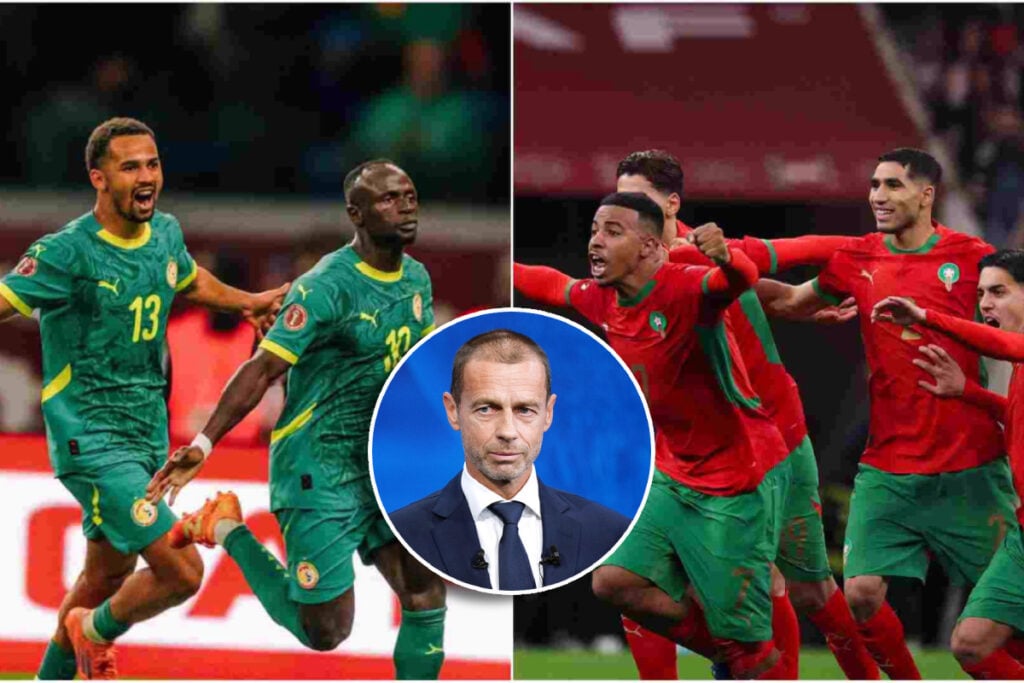
“For our countries, no World Cup match is insignificant. Qualifying for this competition is a historic achievement and the culmination of a dream held by entire generations. To claim that some matches have less value is to disregard the sacrifices, efforts, and ambitions of players, coaches, officials, clubs, and millions of fans around the world,” the statement reads.
The signatories also emphasized that football should not belong to an elite few. “The strength of football lies in its universality. The World Cup is the biggest sporting competition on the planet because it brings together different cultures, histories, and journeys. Every nation that qualifies has earned it and deserves respect. Every team has won its place on the pitch. Every match matters,” the federations concluded, delivering a sharp response to the UEFA president.
World Cup: Senegal’s Statement
Despite ongoing tensions between the two federations over the dispute surrounding AFCON 2025, Senegal and Morocco surprised everyone by adopting a united stance against the criticisms aimed at the new expanded World Cup format. This position goes far beyond the current legal disputes and reflects a desire for unity on broader global football issues.
The expansion of the World Cup to 48 teams has significantly changed the allocation of spots and offered Africa historic representation with ten teams qualifying for the 2026 edition, jointly hosted by the United States, Mexico, and Canada. This is a significant leap from previous editions, where the continent had only five spots, severely limiting its chances of participation.
This reform has also opened doors for several nations that have been waiting decades for such an achievement. Cape Verde has written one of the most beautiful chapters in its history by securing its first qualification for a World Cup finals. In the CONCACAF region and Asia, Curaçao and Uzbekistan have also surprised by validating their tickets for the grand global event, illustrating the widening competitiveness on a global scale.
Other nations have also taken advantage of this new dynamic to reconnect with their past. The Democratic Republic of Congo has returned to the World Cup after 52 years of absence, symbolizing a long-awaited comeback for several generations. Haiti has also managed to return to the global stage, reviving historic memories for its supporters.
In this context, Senegal aimed to promote a more inclusive and fair vision of international football, temporarily setting aside differences with Morocco. This is a strong symbolic gesture, especially since both countries are still engaged in a procedure before the Court of Arbitration for Sport (CAS) regarding the 2025 Africa Cup of Nations. By responding to Aleksander Ceferin’s comments, both federations chose to unite around a common message: the recognition of the merit of all qualified nations and the defense of a more open global football, where every team has its place and every match retains its significance.


