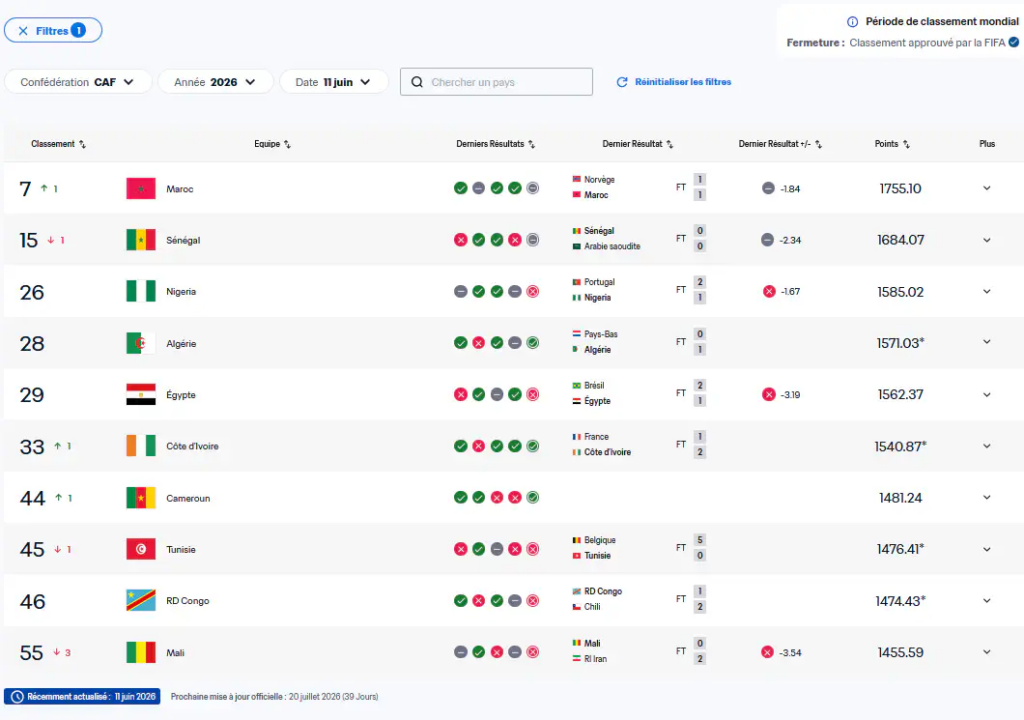
FIFA has released its latest update of the world rankings for national teams, just hours before the kickoff of the 2026 World Cup. This ranking reflects the recent performances of teams in international competitions and friendly matches, providing a snapshot of the current strengths before the tournament begins. In Africa, this ranking confirms the dominance of certain nations firmly established at the top, while also highlighting the ongoing progress of several ambitious teams.
Morocco firmly retains its position as the top African team. With remarkable consistency on the international stage, the Atlas Lions also hold a high spot globally. Senegal remains in second place on the continent, reaffirming its status as a powerhouse of African football, backed by a competitive and experienced generation. Following this top duo, Nigeria completes the African podium, with Algeria and Egypt close behind, two historic teams that remain competitive despite undergoing rebuilding phases.
Côte d’Ivoire continues its rise, breaking into the top 6 African teams, driven by a promising new generation. Cameroon and Tunisia remain regulars in the continental high-level scene, while DR Congo and Mali round out the top 10, showcasing the diversity and growing balance of power on the continent.
This ranking also highlights relatively small gaps between several teams, especially in the mid-table positions, hinting at fierce competition in the coming months, particularly as major international events approach.
FIFA Ranking – Top 10 African Teams (before the 2026 World Cup)
| Rank in Africa | National Team | World Rank | FIFA Points |
|---|---|---|---|
| 1 | Morocco | 7th | 1755.10 |
| 2 | Senegal | 15th | 1684.07 |
| 3 | Nigeria | 26th | 1585.02 |
| 4 | Algeria | 28th | 1571.03 |
| 5 | Egypt | 29th | 1562.37 |
| 6 | Côte d’Ivoire | 33rd | 1540.87 |
| 7 | Cameroon | 44th | 1481.24 |
| 8 | Tunisia | 45th | 1476.41 |
| 9 | DR Congo | 46th | 1474.43 |
| 10 | Mali | 55th | 1455.59 |
This snapshot of African football confirms a largely stable hierarchy at the top, with Morocco and Senegal clearly dominating the discussions. However, the density of the rankings among other nations shows that positions can quickly change based on performances in official competitions and upcoming international windows.
As we approach the 2026 World Cup, this momentum raises expectations around African teams, who will be looking to turn their potential and progress into concrete results on the global stage.