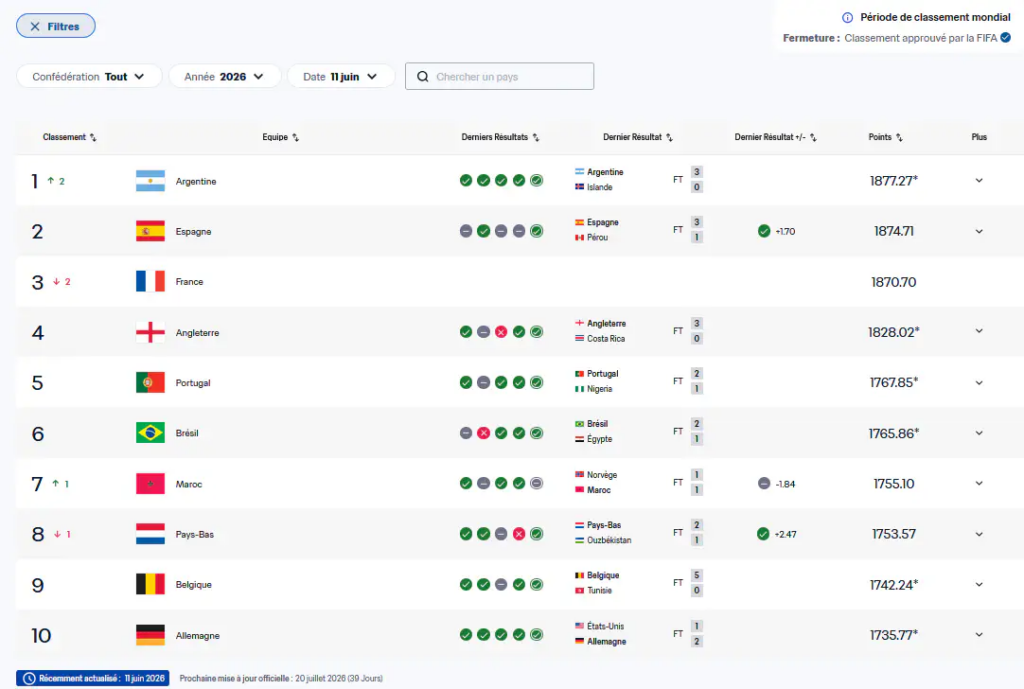
With just hours to go before the kickoff of the 2026 FIFA World Cup hosted by the United States, Canada, and Mexico, FIFA has released its latest update of the world rankings for national teams. This ranking, based on the recent performances of teams, serves as an important indicator of current trends in international football, even if it doesn’t guarantee the outcome of the tournament.
This update comes amid heightened anticipation for the start of the competition, which features 48 nations in an expanded and particularly open edition. The gaps between the major powers in world football appear relatively narrow, reflecting a gradual leveling of standards at the highest level. Several teams enter the tournament with legitimate ambitions of claiming the world title.
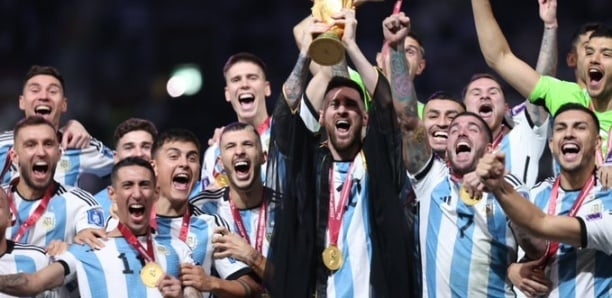
At the top of the ranking, Argentina maintains a dominant position with 1877.27 points, confirming its consistency at the summit of world football. Spain closely follows with 1874.71 points, while France holds third place with 1870.70 points after a slight drop. England remains in fourth place with 1828.02 points, staying in the mix of serious contenders.
Portugal and Brazil occupy the fifth and sixth positions respectively, separated by a very slim margin, illustrating their closeness in current level. Morocco makes a notable leap to seventh place, confirming its rise on the international stage. The Netherlands slips slightly to eighth, while Belgium and Germany round out the Top 10.
FIFA Ranking – Top 10 (update before the 2026 World Cup)
| Rank | Team | FIFA Points | Change |
|---|---|---|---|
| 1 | Argentina | 1877.27 | +2 |
| 2 | Spain | 1874.71 | = |
| 3 | France | 1870.70 | -2 |
| 4 | England | 1828.02 | = |
| 5 | Portugal | 1767.85 | = |
| 6 | Brazil | 1765.86 | = |
| 7 | Morocco | 1755.10 | +1 |
| 8 | Netherlands | 1753.57 | -1 |
| 9 | Belgium | 1742.24 | = |
| 10 | Germany | 1735.77 | = |
Beyond the numbers, this ranking provides a glimpse into the strengths at play before the competition kicks off. It highlights the stability of the major historical football nations while also showcasing the emergence or confirmation of teams like Morocco, now firmly established among the world’s best.
However, the history of past World Cups reminds us that the FIFA ranking remains a relative indicator. Knockout stages often come down to details, and the theoretical gaps observed before the tournament can quickly vanish in the heat of direct elimination matches.
In this context, the favorites must confirm their status on the pitch, while several outsiders aim to shake up the established hierarchy. The 2026 edition promises to be a fiercely contested competition, where current form and management of crucial matches could weigh more than the theoretical ranking set before the tournament.